All-in-One Solar CRM: Stop Juggling Tools and Start Closing More Australian Solar Jobs
If you're running a solar business in Australia and still using spreadsheets for leads, one tool for design, another for quotes, and email for follow-up, you already know what it costs you. Lost leads, duplicate data entry, quotes sent too late, and jobs that fall through because someone forgot to chase a contract signature. An all-in-one solar software platform fixes this by putting lead management, design, quoting, scheduling, contracts, and reporting in one system. SolarHub CRM is built for Australian solar retailers and installers who want to cut admin time, speed up sales, and keep their team on the same page without switching between five different apps.
Why Australian Solar Businesses Need Software That Actually Integrates

Australia leads the world in rooftop solar uptake, which is brilliant for the industry but also means competition is fierce and customers expect fast, professional service. If your quote takes three days to turn around because you're stitching together tools, you've already lost to the installer who sent theirs in an hour. An all-in-one platform solves this by connecting every step of your workflow.
The challenges Australian solar businesses face include:
- Complex regulations from the Clean Energy Council and varying state-specific rules that require careful compliance tracking
- Diverse climates and roof types across Perth, Brisbane, Melbourne, Sydney, Adelaide, and Hobart that demand precise solar panel design and shading analysis
- High customer expectations for professional proposals, accurate energy production estimates, and clear bill savings projections
- Operational overheads from managing leads, designing systems, generating quotes, scheduling installations, and tracking payments across multiple disconnected platforms
An integrated solar software platform addresses these pain points by consolidating your workflow and giving you the tools to manage every aspect of your business from one place. It's not just about having software — it's about having software that understands the nuances of the Australian solar market and how solar retailers and installers actually work.
What True All-in-One Solar Software Actually Includes
The term "all-in-one" gets thrown around, but if you still need three other apps to run your solar business, it's not genuinely integrated. A proper all-in-one solar software solution handles every critical function in a single, connected platform. Think of it as the central operating system for your entire solar business.
This means:
- Data flows automatically between functions — information captured during lead generation populates design proposals and customer communication without manual re-entry
- Workflows connect from initial site assessment and solar panel design through to proposal generation, contract management, and invoicing.
- Your management team, sales team, and installation crew all work from the same up-to-date data, improving coordination and productivity.y
- You get a complete view of your solar business performance through integrated analytics and reporting, helping you make decisions based on actual data instead of guesswork.rk
This integrated approach is what sets platforms built for solar businesses apart from generic CRMs or standalone design tools that don't talk to each other.
Core Features Your Solar Software Platform Should Cover
To genuinely deliver value and replace the mess of spreadsheets, disconnected tools, and manual processes, an all-in-one solar software needs a robust set of features tailored to how solar businesses operate. Here's what matters:
Lead and Customer Relationship Management
Track and nurture every opportunity from initial contact through to conversion and post-installation follow-up. Smart lead allocation ensures leads get assigned to the right sales rep automatically, and automated follow-up reminders mean no opportunity falls through the cracks. Solar quoting software that integrates with your CRM saves hours per week on quote creation and customer communication.
Centralise all customer interactions — emails, calls, notes, proposals — in one comprehensive customer profile. Integrated email marketing tools let you run targeted campaigns, send automated follow-ups, and keep customers engaged throughout their clean energy journey. Smart integrations with Facebook, Google Sheets, and landing pages streamline lead capture and eliminate manual data imports.
Solar Design and Proposal Tools
Use advanced design software for accurate solar panel placement that factors in roof orientation, tilt, and shading analysis. This includes the ability to map panel layouts for varied Australian roof types, calculate energy production based on local climate data, and size systems for residential or commercial jobs,o bs including battery storage.
Generate professional design proposals with detailed energy production estimates and bill savings projections in a few clicks. The proposal should pull directly from your design data, pricing library, and customer details without manual copying and pasting. Built-in design tools ensure every proposal is accurate, compliant, and ready to send within minutes of completing the site assessment.
Site assessment tools should let you collect critical data digitally, sync it automatically to your design module, and eliminate the paper forms and manual data transfer that slow down your quoting process.
Job Scheduling and Team Coordination
Once a job is sold, your platform should handle scheduling site visits, installation dates, inspections, and maintenance appointments through an integrated calendar system. Calendar sync keeps your installers and admin team aligned, and role-based permissions mean sales reps see what they need while project managers control job timelines and resource allocation.
Solar business management software with built-in scheduling removes the back-and-forth emails, phone calls, and missed appointments that delay installs and frustrate customers. Your team can see live updates on job status, assign tasks, and coordinate efficiently without switching tools.
Financial Management and Invoicing
Generate professional invoices tied to each job, track payments, and monitor outstanding balances in real time. Quote management should cover everything from initial estimates through to final contracts, with transparent pricing that accounts for panel costs, inverters, battery storage, installation labor, and any applicable rebates or incentives.
Integration with accounting software like Xero or MYOB ensures your financial records stay accurate without duplicate data entry. For businesses managing dozens of active solar jobs simultaneously, this removes the guesswork from cash flow and accounts receivable, and speeds up the process from contract signing to payment received.
Contract Management and E-Signature
Printing, signing, scanning, and emailing contracts is slow and holds up cash flow. E-signature capabilities let customers sign from their phone or laptop, and the signed contract automatically attaches to their job record in your system. This cuts contract turnaround from days to hours, which matters when customers are comparing quotes from multiple installers and making decisions fast.
Document management should store all project-related files — permits, certifications, compliance documents, site photos, design files — in one accessible location tied to each customer record.
Analytics, Reporting, and Performance Monitoring
See how many leads came in this week, which sales rep closed the most jobs, average quote value, lead source conversion rates, and project profitability in real time. This data helps you spot problems early — if quote-to-close rates drop, you know to review pricing or provide additional sales training.
For solar businesses with installed systems, monitoring software can track solar panel and inverter performance, ensuring optimal energy production and identifying any issues before customers notice them. Real-time management analytics give owners and operations managers the visibility needed to make proactive decisions instead of just reacting to problems.
How SolarHub CRM Replaces Your Patchwork of Tools
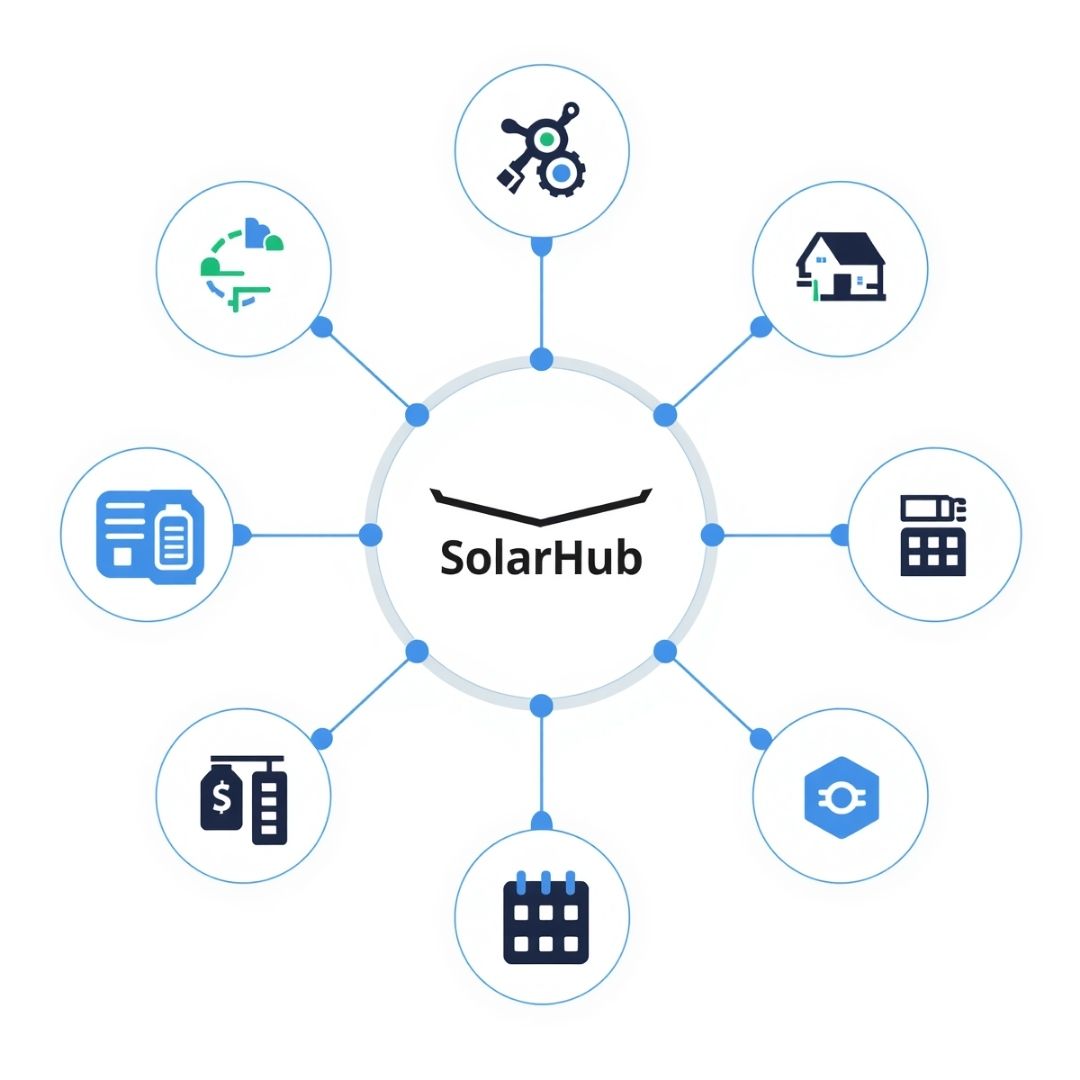
SolarHub CRM is built specifically for Australian solar retailers and installers. It replaces the spreadsheets, standalone design tools, and disconnected CRMs that most solar businesses start with. It understands the workflow from lead capture through to final inspection and post-installation support.
Here's what it handles in one platform:
- Lead management with automatic assignment to the right sales rep and follow-up reminders
- Integrated solar design tools for precise panel layouts, shading analysis, and system sizing
- Solar proposal generation with accurate energy production estimates, bill savings calculations, and professional PDFs
- E-signature for fast contract turnaround without printing and scanning
- Job scheduling with calendar sync so your install team and office staff see the same live schedule
- Email and SMS automation for customer updates, follow-up reminders, and post-installation check-ins
- Role-based access control for sales reps, installers, project managers, and admin staff
- Real-time reporting on sales performance, revenue, pipeline health, and team productivity
- Integration with accounting software, ad platforms, and supplier systems to keep data flowing
For a typical 5–10 person solar business, this setup saves a few hours per week per sales rep on admin tasks like data entry, quote creation, and follow-up emails. For larger teams with multiple installers and project managers across different regions, it scales without adding complexity or requiring more manual coordination.
Traditional Workflow vs. Integrated Platform: What Changes
| Process Stage | Traditional Workflow (Disjointed Tools) | All-in-One Software Workflow (SolarHub CRM) |
|---|---|---|
| Lead Generation | Manual entry from web forms into spreadsheets; separate tools for Facebook and Google ads | Automated capture from website, social media, and integrations; learn ads are auto-assigned to the sales rep instantly. |
| Site Assessment | Paper forms, phone photos, and manual data transfer to the design tool later | Digital site assessment tools; data auto-syncs to the design module and populates the customer record. |
| System Design | Separate solar panel design software; export PDF and manually attach to the quote document | Integrated design software with shading analysis, panel layout, and energy estimates flows into the proposal automatically |
| Proposal and Quote | Manually build a quote in Word or Excel; copy pricing from supplier sheets; email as an attachment. | Quote generated from design data, pricing library, and customer details in a few clicks; sent directly from the platform.m |
| Customer Communication | Scattered emails, phone notes in different systems, no single source of truth | Centralised communication history; automated email marketing and SMS updates; all visible in the customer profile |
| Contracting | Print contract, sign, scan, email to customer; wait for them to print, sign, scan, and return. | E-signature sent from platform; customer signs digitally; signed contract auto-filed to job record |
| Scheduling | Phone calls and shared Google Calendar; manual updates; installers' check separate schedule | Integrated calendar; installers and office staff see live schedule; automatic notifications for changes |
| Invoicing | Create an invoice in a separate accounting tool; manually link to the job; track payments in a spreadsheet | Invoice generated from job data; payment tracking in one system; syncs to accounting software |
| Reporting | Pull data from multiple sources; manually build reports in Excel; outdated by the time you finish. | Real-time dashboards for sales, revenue, pipeline, and team performance; drill down into any metric instantly |
Why Australian Solar Installers Choose Integrated Platforms

The Australian solar market moves quickly. Rebates change, new battery products launch, Clean Energy Council rules get updated, and customer expectations keep rising. A platform built specifically for this market keeps up without requiring you to rebuild your workflows every time something changes.
SolarHub CRM handles Clean Energy Council-approved products, integrates with local suppliers, and supports teams working across Sydney, Melbourne, Brisbane, Perth, Adelaide, Hobart, and regional areas. It's designed for the way Australian solar businesses actually operate — not generic business software that happens to work for solar companies if you configure it heavily enough.
For businesses that started with basic tools and hit the limits — too many leads to track in spreadsheets, too many follow-ups falling through the cracks, too much time wasted building quotes manually — an integrated platform is the next logical step. It's not about adding features you don't need. It's about making the features you do need work together so your team can focus on selling and installing instead of admin work and data entry.
Choosing the Right Platform for Your Solar Business
When evaluating all-in-one solar software options, here's what to check before committing:
- Does it handle leads, design, quotes, contracts, scheduling, and invoicing in one system, or do you still need other tools to fill gaps?
- Is the design module accurate for Australian conditions — roof types, shading, local climate data, Clean Energy Council compliance, and panel specifications?
- Can it integrate with your existing tools like Xero, MYOB, Facebook ad platforms, Google Sheets, and supplier systems?
- Does it scale as your team grows, with role-based permissions, multi-user support, and performance that doesn't slow down with more data?
- What kind of support do they offer — email only, or phone support from people in Australia who understand solar workflows and can help when you're stuck?
- Is there a free trial or demo so you can test it with real jobs, real leads, and your actual team before making a decision?
For most solar businesses, the return on investment comes from three areas: time saved on admin (typically a few hours per rep per week), faster quote turnaround (quotes sent same day instead of next day or later), and fewer lost leads (automatic follow-ups instead of relying on manual reminders that get forgotten). Calculate what that's worth for your team size, job volume, and average project value.
Real Impact: How Integrated Software Changes Daily Operations
The benefits of implementing a proper all-in-one solar software platform extend well beyond just convenience or having fewer logins to remember. Here's what changes in practice:
- Increased efficiency from automating repetitive tasks, eliminating manual data entry, and streamlining workflows frees up your team's time for higher-value activities like sales calls, site visits, and customer relationship building
- Enhanced accuracy by removing human error from calculations, proposals, and project management leads to more reliable energy production estimates, correct system sizing, and fewer costly mistakes that require rework.
- Faster sales cycles through professional proposal generation, quick e-signature capabilities, and efficient customer communication mean you close more jobs before competitors even send their quote.s
- Improved customer satisfaction from delivering a smooth, professional experience from first contact through to post-installation support builds trust, generates referrals, and creates long-term relationships
- Better decision-making powered by real-time analytics and detailed reporting gives you actionable insights into business performance, helping you identify what's working, fix what isn't, and spot opportunities early
- Cost savings from reducing errors, rework, duplicate data entry, and inefficient processes directly impact your bottom line and let you operate leaner without sacrificing quality
For solar installers and retailers managing anywhere from a dozen to hundreds of jobs per year, this translates into a more profitable, sustainable, and frankly less stressful business to run day-to-day.
Staying Competitive as the Solar Industry Evolves
The renewable energy landscape keeps changing. Battery storage technology improves, smart grid integration becomes more sophisticated, new solar panel products launch, inverter technology advances, and government incentive programs shift. An advanced all-in-one solar software platform needs to be adaptable and scalable,e so your business can embrace these changes without having to replace your entire system.
By choosing a platform that offers regular updates, solid Australian-based support, and a clear commitment to the solar industry, you're not just buying software for today. You're investing in a foundation that lets you remain competitive, explore new product offerings like advanced battery storage solutions, and continue providing exceptional service to homes and businesses across Australia for years to come.
The solar businesses that thrive are the ones that invest in the right systems early, get their operations running smoothly, and focus their energy on growth and customer service instead of fighting with tools that don't work together.
Common Questions About All-in-One Solar Software
What is an all-in-one solar software, and who should use it?
An all-in-one solar software is a complete platform that integrates every essential business function for solar companies — CRM, solar design, proposal generation, project management, invoicing, and analytics — in one system instead of using separate disconnected tools. It's built for Australian solar retailers, installers, and businesses of any size looking to reduce admin work, speed up sales, and improve operational efficiency. If you're currently using spreadsheets for lead tracking, separate tools for design and quoting, and email for customer communication, an integrated platform will save your team significant time every week.
How does all-in-one solar software help Australian solar businesses save money?
It saves money in several ways: automating tasks that currently take manual effort reduces labor costs; eliminating errors in quotes, designs, and system sizing prevents costly rework and customer dissatisfaction; improving sales conversion rates through faster, more professional proposals means more revenue from the same lead volume; optimising project management and scheduling reduces wasted time and improves installer productivity; and providing data-driven insights helps you allocate resources more effectively and identify unprofitable activities to cut. Most businesses see a return on investment within a few months from time savings alone.
Does SolarHub CRM include solar panel design software?
Yes, SolarHub CRM features robust integrated solar panel design software built directly into the platform. This lets you accurately design solar systems, perform shading analysis, calculate energy production based on roof orientation and local climate, size systems for residential and commercial projects, and generate professional design proposals — all without leaving the platform or exporting and importing data between separate tools. The design module is built specifically for Australian conditions and Clean Energy Council compliance.
Is SolarHub CRM suitable for both small and large solar installers in Australia?
Absolutely. SolarHub CRM is designed to scale from small local installers with 2–3 people through to large enterprises with operations across multiple cities and dozens of team members. The platform offers flexible role-based permissions, multi-user support, and features that adapt to your business size and complexity. Whether you're a single-person operation in Adelaide handling a few jobs per month or a large team across Sydney, Melbourne, and Brisbane managing hundreds of active projects, the system grows with you without requiring a complete rebuild of your workflows.
What kind of customer support can I expect from SolarHub?
SolarHub provides dedicated support specifically for Australian solar businesses, with local phone and email support from a team that understands solar workflows, industry regulations, and the practical challenges you face running a solar business day-to-day. Support includes onboarding assistance to get your team up and running quickly (typically within a week for most businesses), ongoing training resources, and responsive help when you need it. This is not offshore call center support reading from scripts — it's knowledgeable assistance from people who understand the Australian solar industry.
Can the software handle both residential and commercial solar jobs?
Yes. The platform supports varying system sizes, panel configurations, and job complexities. Whether you're quoting a 6kW residential rooftop in suburban Melbourne or a 100kW commercial system with battery storage for a warehouse in Brisbane, the workflow is the same. You can manage different pricing structures, product options, compliance requirements, and project timelines all within one system without needing separate tools for different job types.
What if we already use accounting software like Xero or MYOB?
SolarHub CRM integrates with popular accounting platforms, so invoices, payments, and financial data sync automatically. You don't need to replace your accounting system — the CRM handles the solar-specific functions like lead management, design, quoting, job scheduling, and customer communication, then feeds the financial data to your existing accounting setup. This eliminates duplicate data entry and keeps your books accurate without adding extra manual work.
Set Up Your Solar Workflow in One Integrated System
If your current setup involves juggling multiple tools, chasing down lost leads in spreadsheets, manually building quotes, waiting days for contract signatures, or struggling to keep your team coordinated across jobs, an all-in-one platform will change how your business operates daily. The time you save, the errors you prevent, and the customers you close faster all add up quickly.
SolarHub CRM is built for Australian solar retailers and installers who want to run lean operations, close more work, and spend less time on admin and more time on growth. It's software designed by people who understand how solar businesses actually work, not generic business tools adapted for solar with workarounds and compromises.
Visit solarhubcrm.com.au to book a demo, see the platform in action with real solar job workflows, and talk to the team about how it fits your specific business needs.